Follow the active discussion
Keep transcript segments and analysis connected to the current agenda item instead of treating the meeting as one undifferentiated conversation.
BoardCue follows the active agenda item and combines the live discussion with board papers, previous meetings, risks, actions and decisions to privately surface relevant prompts while they can still influence the conversation. Not a meeting bot. Not a generic transcript.
Available to individual board members and organisation deployments.
Live Mode is designed for the few seconds in which a board member decides whether to intervene. It identifies the material governance issue in the active discussion, checks it against relevant history and filters potential observations before placing anything in front of the user.
Keep transcript segments and analysis connected to the current agenda item instead of treating the meeting as one undifferentiated conversation.
Compare what is being said with the current paper, earlier meetings, risks, actions, decisions and relevant organisational context.
Prioritise what most needs attention and suppress low-confidence, repetitive, already-answered or poorly timed suggestions. No prompt is better than a distracting one.
Present a concise observation or potential question that can be understood quickly, with supporting evidence available when the user needs it.
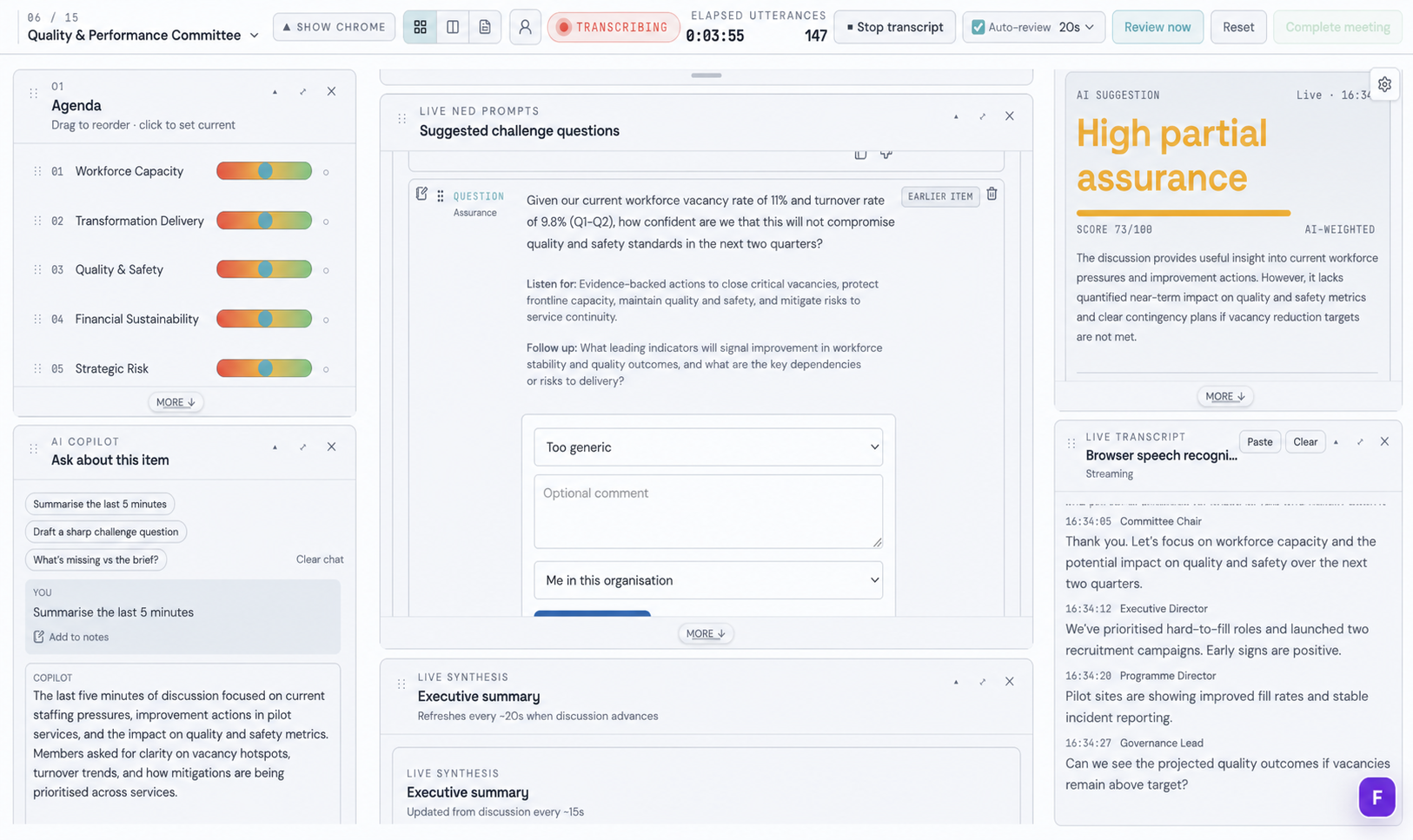
Current BoardCue Live interface · anonymised demonstration data
BoardCue does not speak into the meeting or decide that a challenge must be made. The user can inspect the evidence, adapt the wording, save the issue for later or dismiss it entirely. That control matters because tone, timing and organisational context cannot be delegated to a model.
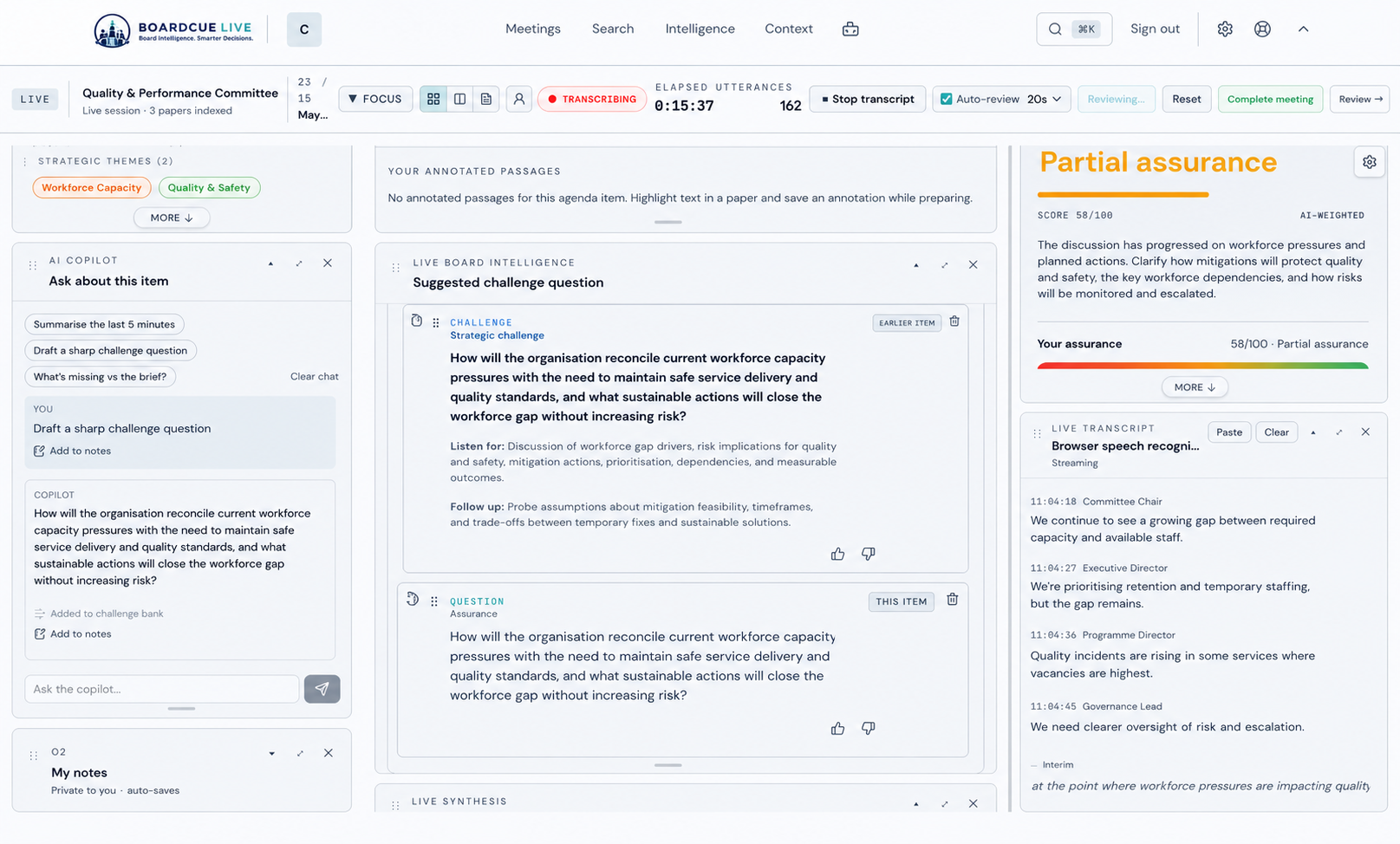
Current BoardCue Live interface · anonymised demonstration data
Decision Lens analyses the discussion so far and helps the user distinguish the real decision from surrounding debate. It brings together the options under consideration, emerging direction, relevant history and source-backed evidence, then makes gaps, assumptions and governance risks explicit before the board commits.
Identify the actual decision, underlying or conflated questions and the options visible in the discussion without inventing a decision where none is emerging.
Set out evidence supporting and challenging the options, distinguish source-backed material from AI interpretation and show where evidence is missing.
Surface explicit and inferred assumptions, alternative interpretations, governance risks and the conditions that may need to be satisfied.
Explain whether the decision appears ready, ready with conditions, not ready or unclear, including the strongest question and missing requirements.
Use focused follow-ups such as “Argue the opposite case”, “What am I missing?” and “Are we ready to decide?” while keeping the user responsible for the conclusion.
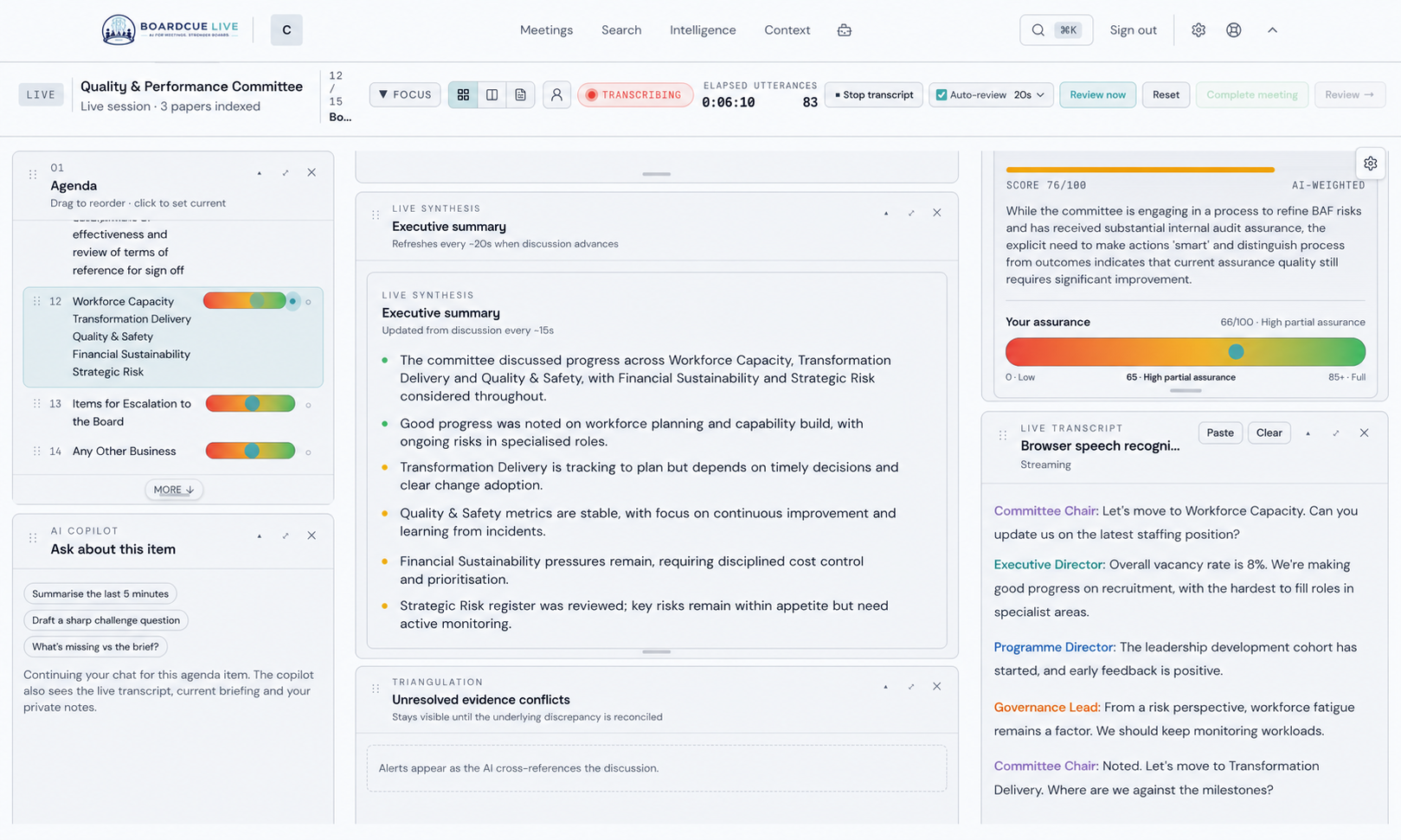
Current BoardCue Live interface · anonymised demonstration data
Bring the discussion back to outcomes, direction and long-term impact.
Test whether claims are supported by evidence and appropriate controls.
Reconnect the current discussion with earlier decisions and commitments.
Identify material areas that have not yet received sufficient attention.
When a live discussion relates to an existing concern, BoardCue can bring the previous challenge and outstanding assurance back into view without forcing you to reconstruct the history during the meeting.
BoardCue distinguishes source evidence from AI interpretation. Significant insights provide a route back to the underlying paper, meeting, risk, action, decision or transcript evidence where that source linkage is supported.
AI supports human judgement. It does not replace board responsibility or make decisions for the user.